Exterior House Painting
Full exterior repaints with washing, scraping, caulk and two coats, scheduled around Dallas heat and HOA rules.
See exterior house paintingDallas clay soil and summer heat pull caulk joints apart around windows, doors and trim, and those open gaps let water and hot air into the walls.
A typical caulk-only visit on a single-story Dallas home runs $465 to $1,380 and takes one to two days. The crew cuts out failed caulk, cleans the joints, adds backer rod to deep gaps and runs a paintable exterior sealant matched to each joint. The in-home walk-through sets the real number after we count joints and check the gaps.
Most of the cracked caulk we see in Dallas comes from movement, not age alone. Expansive clay soil swells after a wet spring and shrinks hard in an August drought, and the house shifts slightly with it. That pulls window frames, door casings and trim boards a little apart each season, and stiff caulk splits instead of stretching.
Heat finishes the job. South and west walls take direct sun for hours, and the joints on them expand and contract every day. Cheap acrylic caulk dries out and shrinks under that UV, leaving a hard, cracked bead that has pulled off one side of the gap. Water runs into the opening during the next storm and sits behind the trim.
Open joints also leak air. On older homes in Kessler Park or Lakewood, gaps around original wood windows can let hot attic and outside air into rooms, which makes the AC work harder through the summer. Older builds are not the only problem. Newer homes often went up with builder-grade caulk that cracks within the first few summers, so a house only five or six years old can already have open joints around every window.
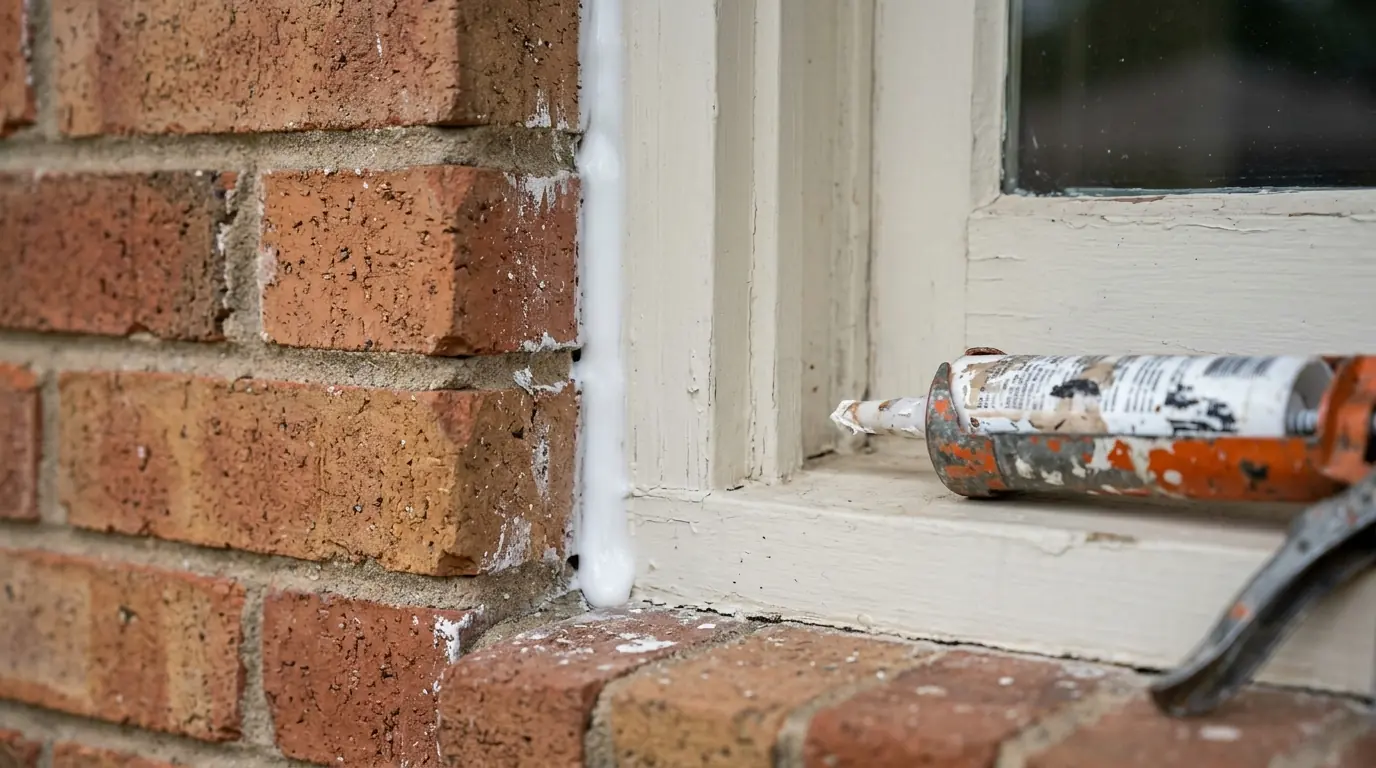
We work around the whole exterior and seal every joint that should be closed. The goal is to keep water out while still letting the wall dry, so a few gaps are left open on purpose. The bottom edge of lap siding and the weep holes along the base of brick walls need to stay open, and we never caulk over them.
On brick homes, the joint where brick meets wood trim or window frames is a common failure spot, as are the vertical expansion joints in long brick runs. On Hardie siding in Frisco, McKinney and Prosper, the butt joints and the joints where siding meets corner boards and window trim need attention.
The walk-through sets your real number, written line by line.
One tube does not fit every gap. For trim and siding joints that will be painted, we use a high-grade paintable sealant with strong stretch, such as an elastomeric or hybrid polymer product from Sherwin-Williams or a similar maker. For joints between brick and window frames that move more, a polyurethane or hybrid sealant holds better. Silicone is reserved for spots that will never be painted, because paint will not stick to it.
Joint depth matters as much as the product. A gap wider than about a quarter inch gets foam backer rod pressed in first so the sealant sets in a thin hourglass shape that can stretch. A bead packed too deep or too thin tears on its first hot summer. We tool every bead so it bonds to both sides and sheds water.
Old caulk gets cut out, not covered. New sealant laid over a cracked bead only bonds to the old caulk, and it fails the moment the old bead lets go. Color matters on brick and stone joints. Many sealants come in tinted shades such as tan, bronze or limestone, so a joint between brick and a window frame does not show as a bright white stripe against the masonry.
Many homeowners call us for caulking alone because the paint still looks fine but the joints are open. A caulk-only visit is a good way to protect the house between repaints, and we can color-match the sealant or paint the new beads so they blend in with your current trim color.
If you are planning an exterior repaint within the next year, it usually makes sense to do both together, since the caulk gets painted over and the crew is already set up. We also flag any soft wood we find behind failed joints, because water that got in through a gap may have started rot that needs repair before sealing.
We schedule caulking for dry days with surface temperatures in the range the sealant label allows. In summer, crews work the shaded sides of the house through the afternoon.
Cracked or shrunken caulk around windows
Gaps opening where brick meets wood trim
Daylight or drafts around exterior door frames
Water stains on trim below window corners
Caulk pulling loose from Hardie siding butt joints
New drywall cracks after a dry summer
We walk the exterior, measure gap widths and mark every joint that has cracked, shrunk or pulled loose.
Failed beads are cut and scraped out so the new sealant bonds to clean surfaces.
Joints are brushed clean and dry, and deep gaps get foam backer rod at the right depth.
We run the matched sealant into each joint and tool it smooth so it sheds water.
Once the sealant cures, we paint the new beads to match your trim if you want them blended.
A good elastomeric or hybrid sealant applied to a clean, properly sized joint often holds for several years on shaded walls. On hot south and west walls, or on homes with active foundation movement, joints may need touch-ups sooner. We point out the high-movement areas during the walk-through so you know which joints to keep an eye on.
We do not do that. New caulk laid on top of a failed bead only sticks to the old caulk, not to the trim or brick, so it lets go as soon as the old bead fails. Cutting out the old material takes longer but gives the new sealant a clean surface on both sides of the joint.
No. The bottom edge of lap siding and the weep holes at the base of brick walls let water that gets behind the cladding drain out. Sealing them traps moisture and can lead to rot or mold. We leave those gaps open and seal only the joints that are meant to be closed.
Sealing open gaps around windows, doors and wall penetrations cuts down on hot outside air leaking in, which can help the AC keep up in summer. How much it helps depends on how large the gaps are and how the house is insulated. Caulking is one part of air sealing, not a full fix for an old home.
Full exterior repaints with washing, scraping, caulk and two coats, scheduled around Dallas heat and HOA rules.
See exterior house paintingFascia, soffit, window and door trim repaints, including rot fixes and gutters, often done without repainting the whole house.
See fascia, soffit & trim paintingRot repair on sills, door jambs, fascia and siding with epoxy fills or new primed wood, painted to match the house.
See wood rot repairCall and a person answers, day or night. We will set a walk-through and write up every surface before any work starts.