Siding Painting
Siding repaints matched to the material: Hardie fiber cement, old wood lap siding, vinyl and engineered wood panels.
See siding paintingWilshire Heights' 1940s and 1950s cottages have wood and cement siding that chalks in the sun, plus interiors with cracked drywall and dated paneling.
Wilshire Heights sits around Abrams Road and Mockingbird Lane, a few minutes north of the Lakewood shopping center. Its streets filled in later than Lakewood's, mostly from the late 1930s into the 1950s, so the houses are simpler: one-story cottages and early ranches with wood or cement shingle siding, brick wainscots, low gables and single-car garages.
Lots here are a popular target for rebuilds, so a single block can hold an original 1,300 square foot cottage, a remodeled one with an addition and a new two-story. We see all three, and each gets a different plan. Original cottages often have aluminum or wood windows set in thin trim that has been caulked over many times, and those old beads come out before new ones go in.
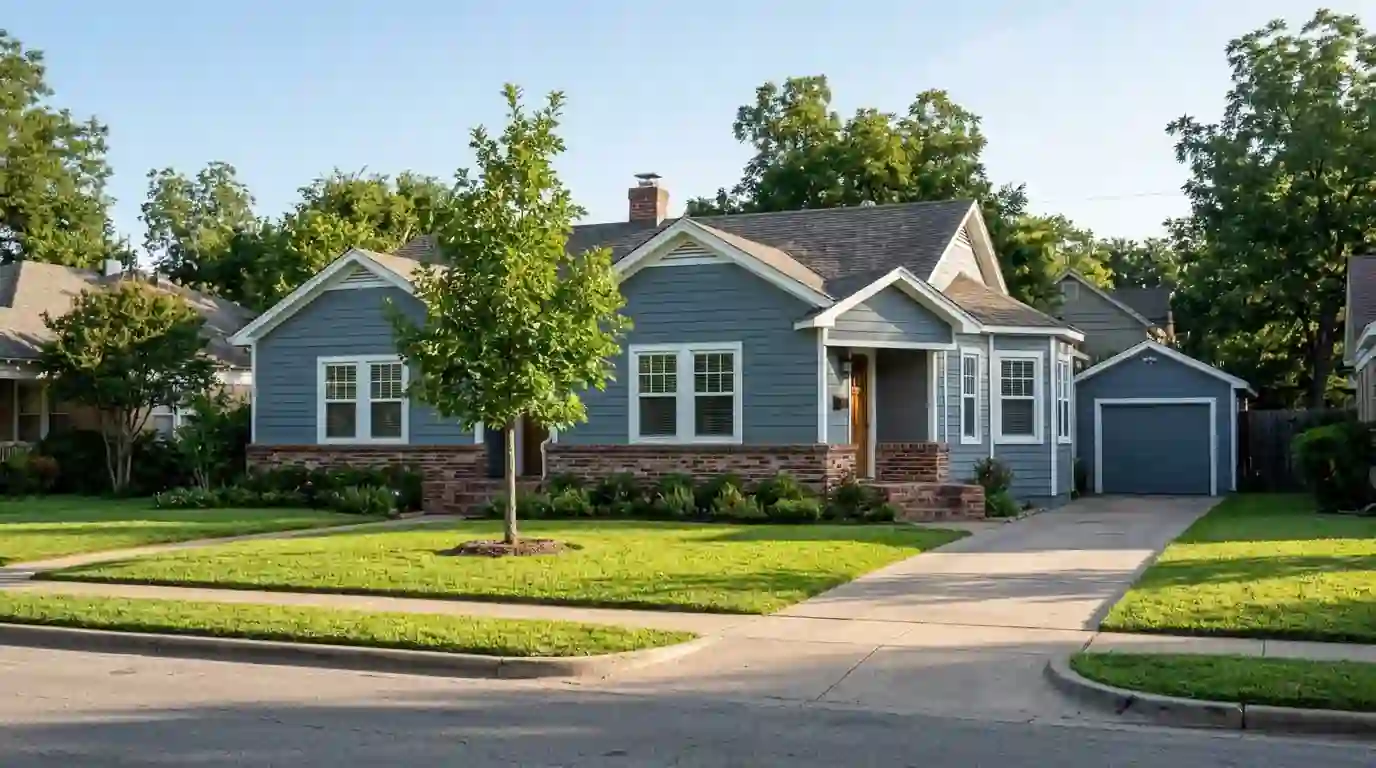
Older siding on these homes shows two problems. Wood lap siding peels at the bottom edge where sprinklers and splash keep it wet, and painted cement shingles chalk until a hand rubbed across them comes away white. We wash chalk off fully, use a binding primer on chalky surfaces, and caulk the butt joints before two acrylic topcoats. Siding Painting goes into each siding type.
A typical exterior on a one-story Wilshire Heights cottage with siding and brick trim falls between $3,970 and $6,580, set by how much loose paint comes off. Remodeled homes with additions often need new and old siding blended so the patch does not show.
Many single-car garages here have wood overhead or swing doors with peeling bottoms and splitting panels. We sand, prime bare wood, caulk the panel joints and finish them in an exterior enamel, often in the same color as the front door so the small elevation reads as one design.
Inside the original cottages, we find knotty pine dens, 1950s wood paneling and drywall that has cracked above doorways as the slab or piers moved. Paneling gets a shellac primer so knots do not bleed, and every crack gets Drywall Repair & Patching before color goes on.
Plenty of original cottages change hands each year. Sellers who want the house to show well call us for Pre-Listing & Move-Out Painting: neutral walls, fresh trim, a newly painted front door and a clean exterior, usually inside a week.
From our Ross Ave office it is about 15 minutes up Central Expressway and east on Mockingbird. Call (945) 422-7607 to reach a person at any hour.
Siding repaints matched to the material: Hardie fiber cement, old wood lap siding, vinyl and engineered wood panels.
See siding paintingTwo-coat wall painting with real prep: crack repair, spot priming, sharp cut lines, and furniture moved and covered.
See interior house paintingCrack, hole, and water-damage repairs taped, textured to match, primed, and painted so the patch does not show.
See drywall repair & patchingFast neutral repaints, patching and trim touch-ups timed to listing photos, closings and tenant turnovers across Dallas.
See pre-listing & move-out paintingYes. Knots bleed through latex, so we clean the paneling, scuff it and prime with a shellac-based primer that blocks the resin. Grooves can be left as a design feature or filled for a flat look, which adds time. Two finish coats in eggshell or satin follow the primer.
That is chalking, the old paint breaking down under years of sun. New paint will not stick well to it. We clean at low pressure without sanding, check that the chalk is gone, and use a primer made to bind chalky surfaces. Broken shingles are pointed out so they can be replaced first.
We can make them look like one house. New siding needs a full primer, and old siding may need scraping and spot priming, so they start at different points. We bring both to the same sheen and color with the same topcoat, and we caulk the joint where old meets new.
A person answers 24/7. Tell us the address and what you want painted, and we will set a time.