Interior House Painting
Two-coat wall painting with real prep: crack repair, spot priming, sharp cut lines, and furniture moved and covered.
See interior house paintingYellowed ceilings, old water rings from an AC drip, and roller stripes you can see from the couch make a whole room look worse than the walls do.
Ceiling painting in Dallas typically runs $1.35 to $2.65 per square foot of ceiling, or about $285 to $560 for a standard 8 to 9 foot bedroom. Vaulted living rooms and two-story entries cost more because they need scaffolding or a plank setup. Price includes stain priming, two flat coats, and cleanup. Your actual price comes from the in-home walk-through.
A ceiling gets light from every window in the room, usually at a low angle, so any roller lap or thin spot shows. Painting overhead also means gravity works against you: too much paint on the roller and it spatters, too little and you get stripes. That is why ceilings are usually the slowest surface per square foot in a repaint.
We roll ceilings in one direction, parallel to the main window wall, and keep each pass short enough to stay wet. Flat ceiling paint with a long open time, such as Sherwin-Williams Eminence or Benjamin Moore Waterborne Ceiling Paint, gives the most forgiving result. Spraying works too in empty rooms or new construction, but in a furnished home rolling gives more control over overspray.
Ceilings are also where texture repairs show worst. If a patch was left smooth and the rest of the ceiling has knockdown, the patch will glow under paint. We match the texture before painting so the repair blends in. Popcorn and heavy knockdown are matched with a hopper gun, while light orange peel can often be rolled on.
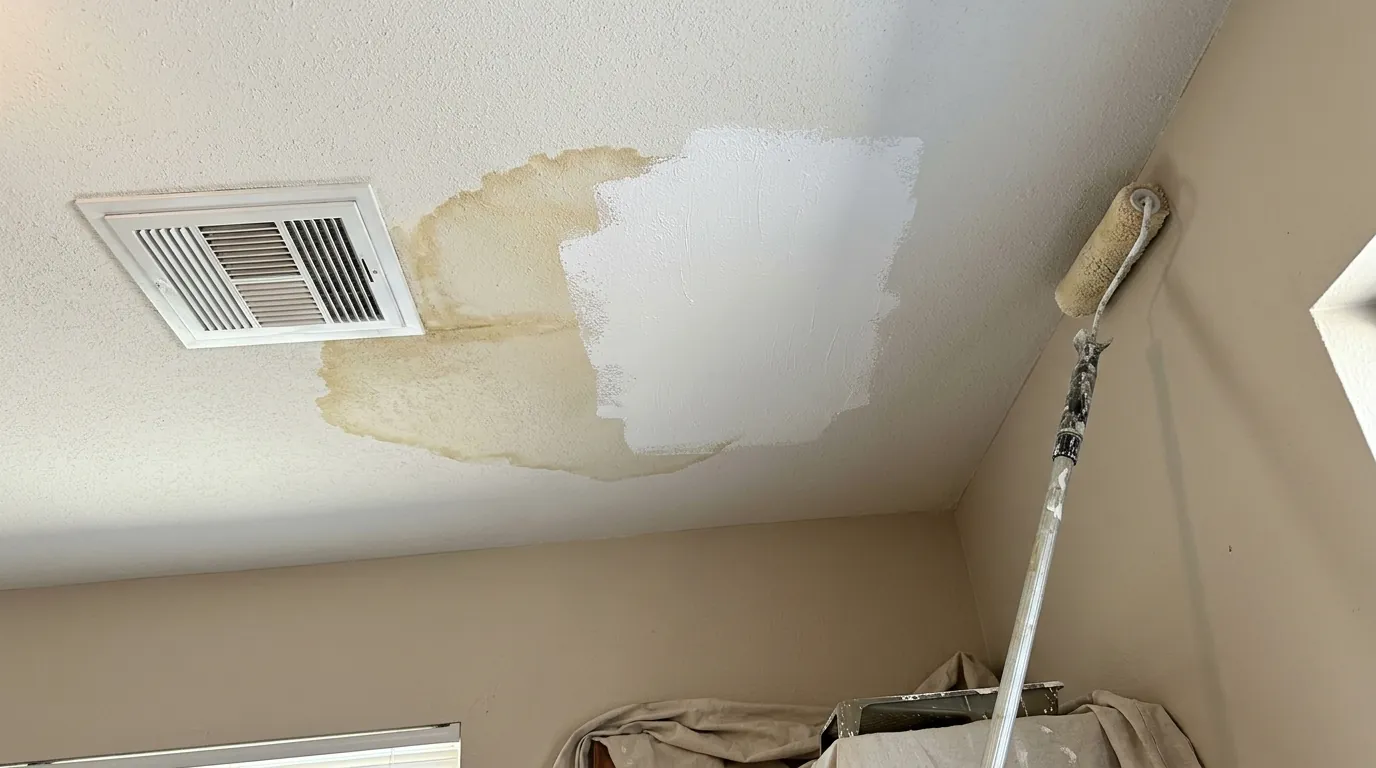
In Dallas, a lot of ceiling stains come from the attic. The air handler sweats hard from June through September, and when a condensate line clogs or a drain pan rusts through, water spreads across the drywall below. Hail damage that lets water past the roof leaves similar brown rings. Bathroom ceilings near the shower show a similar pattern of peeling and dark specks from steam.
Regular latex will not cover those stains. The tannins bleed straight back through within a day. We seal them first with a shellac or oil-based stain blocker, and larger smoke or water jobs are handled as smoke and water stain sealing before the ceiling is painted.
Before sealing anything, the leak has to be fixed and the drywall has to be dry. A moisture meter reading at the walk-through tells us whether it is safe to paint or whether the board needs to come out. If the reading is high, we wait, or bring in a fan and dehumidifier to speed things up before any primer goes on.
The walk-through sets your real number, written line by line.
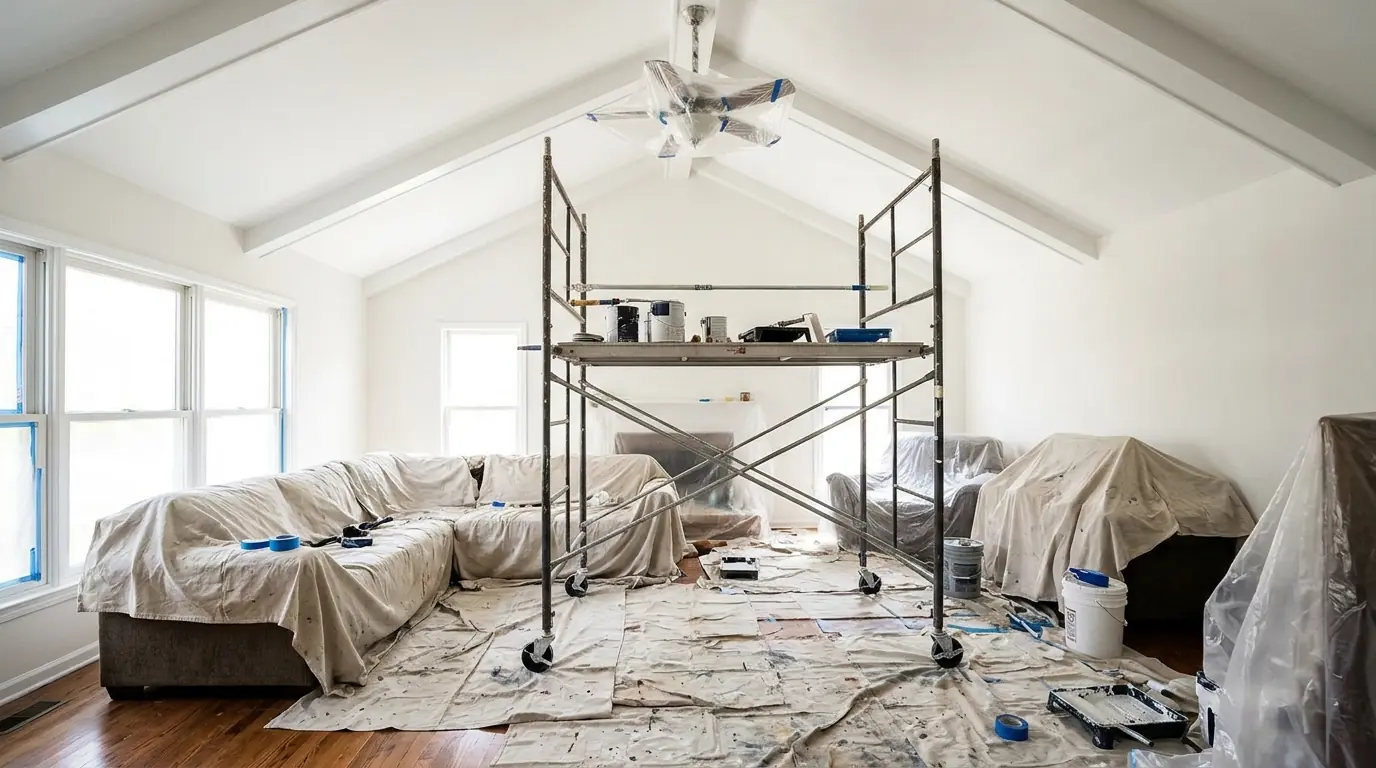
Many homes in Plano, Allen, Coppell, and the newer parts of Far North Dallas have 16 to 20 foot entries and vaulted family rooms. Those need scaffolding or an extension plank on ladders, and they often take longer to set up than to paint. Vaulted slopes also add surface, so the ceiling area can run well past the floor area of the room.
On stairwell ceilings we coordinate with any staircase and railing painting so the scaffold only goes up once. Chandeliers are wrapped in place or lowered, and stair treads and railings are covered before anyone climbs.
Setup time is a real part of the price on tall ceilings, so we quote it as its own line. Once the scaffold is up, we often paint the upper walls and any high window trim at the same time, which saves a second setup later.
Painting a popcorn ceiling is possible, but it is slow and the texture soaks up paint fast. A sprayer works better than a roller, which can pull the texture loose. If the popcorn is already flaking or stained in several places, popcorn ceiling removal is often the smarter use of the money.
Knockdown and orange peel ceilings, common in DFW homes built after the 1980s, paint well with a thick nap roller. Smooth ceilings in older Oak Cliff and East Dallas homes show every flaw, so they get extra patching and a sanding pass before the first coat. Ceilings in older homes may also have hairline cracks along the plaster lath, which get taped before paint.
If you are repainting walls at the same time, we do ceilings first so any drips land on walls that have not been painted yet. The wall color is then cut into the ceiling line for a clean edge. Rooms with dark wall colors get extra care at that line, because a white ceiling makes any wobble obvious.
Brown rings over the AC closet or vent
Ceiling looks yellow next to fresh wall paint
Visible roller stripes in morning light
Old patches stand out from the texture
Smoke film above the fireplace or stove
Peeling paint near a bathroom exhaust fan
We measure each ceiling, note height and access, and check any stains with a moisture meter before quoting.
Floors, furniture, and walls get covered, fixtures are wrapped, and scaffold or planks go up where needed.
Cracks and patches are textured to match, and stains get a shellac or oil-based blocker.
Flat ceiling paint goes on in two coats, rolled in one direction with short wet passes.
We inspect from several angles with lights on and off, touch up, and take down all setup.
Ceiling first, every time. Roller spatter and drips fall down, so painting the ceiling before the walls means any specks land on surfaces that are about to be painted anyway. It also lets the crew cut the wall color into the ceiling line, which gives a sharper edge than cutting ceiling white into a finished wall.
Water stains carry dissolved minerals and tannins from the drywall paper and attic dust. Latex paint is water-based, so it pulls those right back to the surface. The fix is a stain-blocking primer, usually shellac or oil-based, then the ceiling paint. If the stain is still growing, the leak above it has not been fixed yet.
Small touch-ups on a flat ceiling rarely match, even with the same paint, because old paint yellows and its sheen changes as it ages. For a clean result we usually repaint the whole ceiling plane from wall to wall. On very large open-concept ceilings, we can sometimes stop at a beam or soffit line.
Most vaulted family rooms in Dallas take one full day: a few hours to set up scaffold and protection, then sealing, two coats, and teardown. Two-story entries over a staircase can stretch to a day and a half because the setup is more involved. We start these early so the house is back to normal by evening.
Two-coat wall painting with real prep: crack repair, spot priming, sharp cut lines, and furniture moved and covered.
See interior house paintingWater rings, smoke, soot, and nicotine sealed with shellac or oil blockers so stains and odors do not bleed through new paint.
See smoke & water stain sealingTested, contained popcorn removal with ceilings retextured or finished smooth, then primed and painted in the same job.
See popcorn ceiling removalCall and a person answers, day or night. We will set a walk-through and write up every surface before any work starts.