Exterior House Painting
Full exterior repaints with washing, scraping, caulk and two coats, scheduled around Dallas heat and HOA rules.
See exterior house paintingDallas County houses span a century of building, so one crew might scrape 1920s wood siding in the morning and repaint a 1970s brick ranch's trim by afternoon.
Dallas County holds the city of Dallas plus Garland, Mesquite, Irving, Grand Prairie, Richardson, Rowlett, DeSoto and a dozen smaller towns. Our office at 2001 Ross Ave sits near the middle of it, so most addresses in the county are a 15 to 35 minute drive for a crew.
The age spread is what shapes the work. Close to downtown, 75214 and 75204 have wood-sided Craftsman and Tudor homes from the 1920s through the 1940s, many with old oil paint under several latex coats. Farther out, the postwar boom left thousands of brick ranches whose painted surfaces are mostly trim, fascia, soffits and garage doors.
Newer pockets near Lake Ray Hubbard and in the southern towns add stucco, stone and fiber cement to the mix.
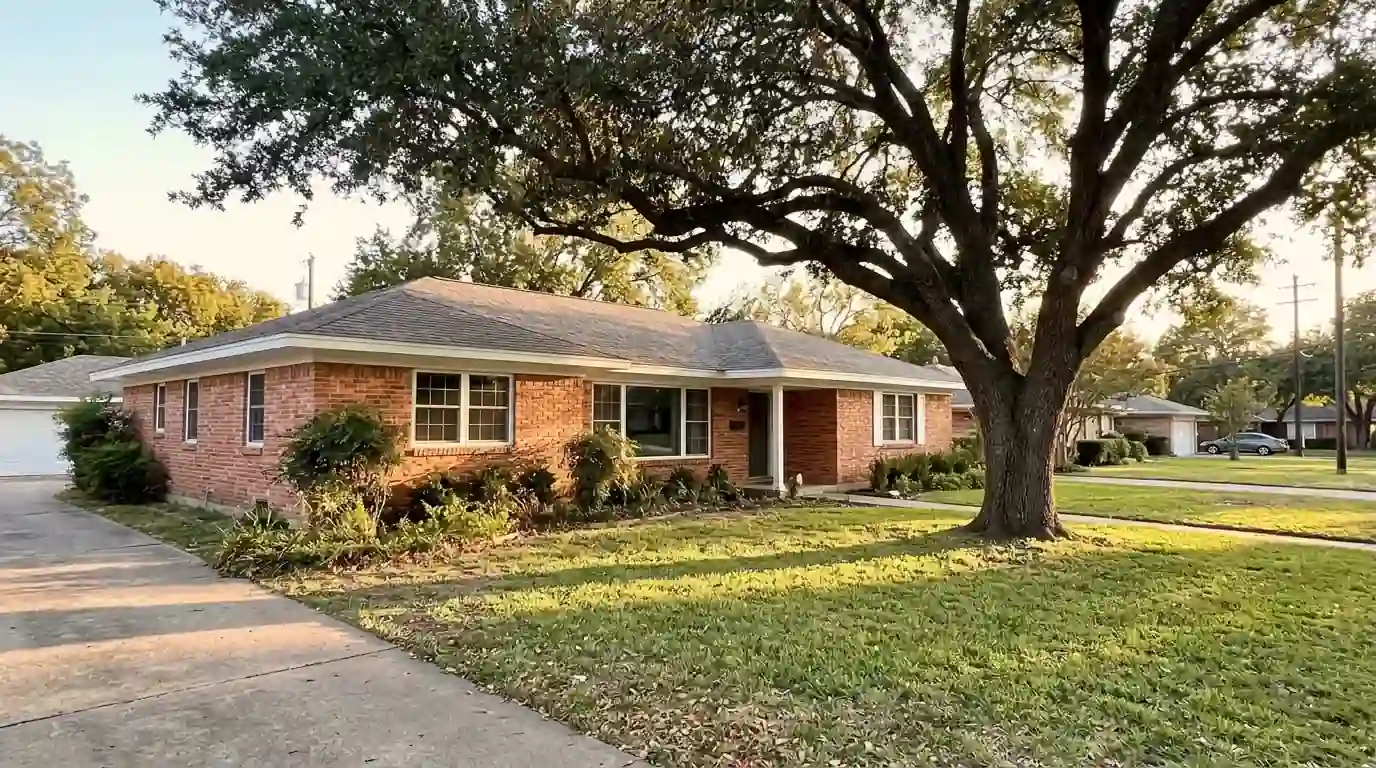
Afternoon sun on west and south walls is the usual culprit. On a typical brick ranch in 75150 or 75040, the fascia boards and window trim on the sunny sides chalk and crack within six to eight years, while the north side stays sound but grows mildew where shrubs crowd the wall.
Clay soil is the other constant. The blackland clay under much of the county swells after spring rain and shrinks in August, and that movement opens caulk joints at brick returns and sends hairline cracks through drywall over interior doors. We recaulk with a flexible sealant and tape and float the cracks before any paint goes on, so the repair holds through the next summer.
Older homes add one more step. Anything built before 1978 gets lead-safe prep: plastic sheeting on the ground, misting while scraping, and HEPA cleanup at the end of each day.
From June through September we start exteriors at first light and follow the shade around the house, keeping brushes off any surface hotter than about 90 F. Interior rooms, Kitchen Cabinet Painting and Drywall Repair & Patching fill the hottest afternoons.
For the trim, doors and fascia on a 2,000 sq ft single-story brick ranch in Dallas County, the typical range is about $2,340 to $4,870. A full-body exterior on a wood-sided 1930s home is a different job and usually lands well above that. Our walk-through at your house turns that range into a firm number, and (945) 422-7607 is answered at any hour if you want to set one up.
DeSoto, Cedar Hill and Duncanville sit on hillier ground along the escarpment, and their 1980s and 1990s brick homes often carry painted siding on upper gables. Inside, the county's oldest homes often have plaster walls patched with drywall over the years. Plaster takes a bonding primer and careful crack repair, while 1970s drywall in Garland or Mesquite usually needs only taping and a fresh coat. We tell you which you have before quoting.
Full exterior repaints with washing, scraping, caulk and two coats, scheduled around Dallas heat and HOA rules.
See exterior house paintingTwo-coat wall painting with real prep: crack repair, spot priming, sharp cut lines, and furniture moved and covered.
See interior house paintingFascia, soffit, window and door trim repaints, including rot fixes and gutters, often done without repainting the whole house.
See fascia, soffit & trim paintingCrack, hole, and water-damage repairs taped, textured to match, primed, and painted so the patch does not show.
See drywall repair & patchingWe work across the whole county, including Dallas, Garland, Mesquite, Irving, Grand Prairie, Richardson, Rowlett, DeSoto, Duncanville and Cedar Hill. Crews leave from our Ross Avenue office, and the southern towns are usually a 25 to 35 minute drive down I-35E or US-67. We group jobs by area so crews spend their day painting, not driving.
It may be. Paint applied before 1978 often contains lead, and many Dallas County homes from that era still carry it under newer coats. We treat every pre-1978 house with lead-safe practices: containment sheeting, wet scraping, no open-flame burning and HEPA vacuum cleanup. If you want a definite answer first, a lead test kit or an independent inspector can confirm it.
Spring and fall give the longest workable days, with mild temperatures and a lighter afternoon sun load. Summer jobs go fine if the crew starts early and works the shaded sides in the afternoon. Winter works on dry days above about 50 F, though cold nights can slow curing on north walls, so we watch the forecast closely.
A person answers 24/7. Tell us the address and what you want painted, and we will set a time.